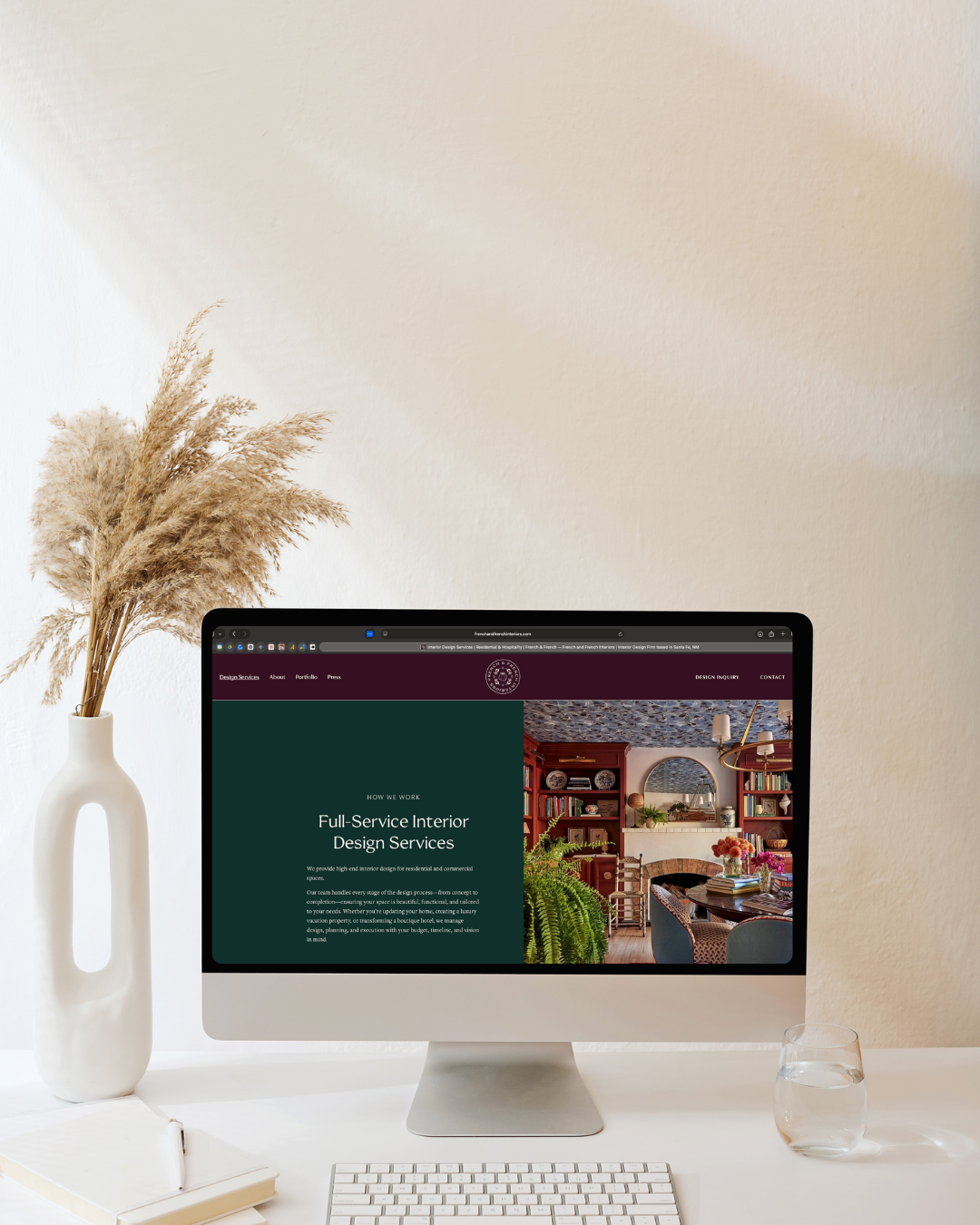
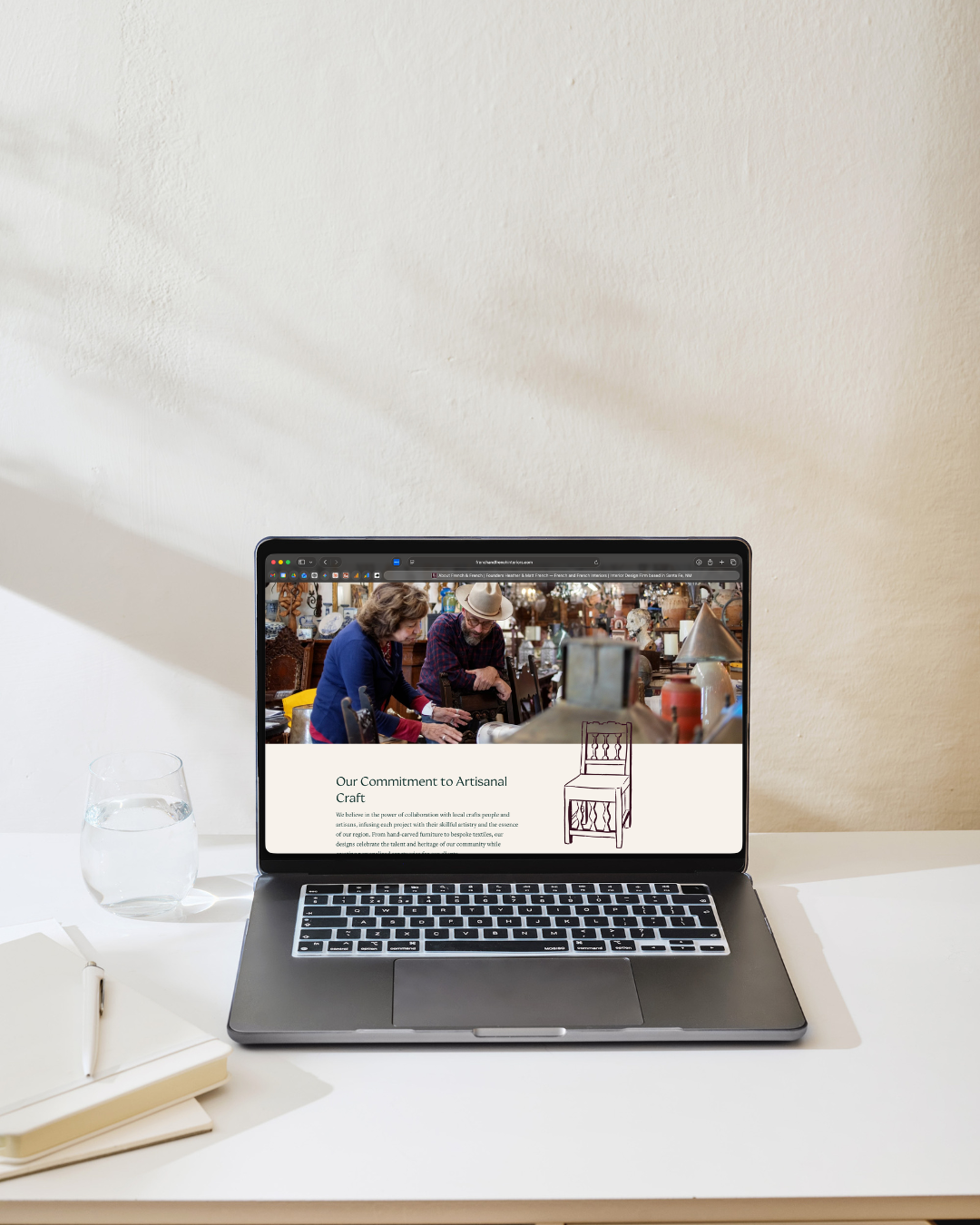
The mandate was not to produce more content. It was to build the system that would make existing authority legible — to search engines, to AI answer engines, and to the national market French & French had already earned the right to serve.
PILLAR 01 — Technical Decoupling & Infrastructure
THE SYSTEM
The first phase treated the website as a high-performance asset rather than a digital brochure. Legacy redirect chains were resolved, eliminating the fractured crawl paths that had been quietly suppressing discoverability. The header architecture was rebuilt from the ground up into a clean H1–H3 hierarchy — a structured map that search systems could interpret without friction.
The platform migration to Squarespace stabilized the underlying infrastructure. Mobile performance scores climbed into the 90s. Security hardening — DMARC configuration and Google Workspace integrity — ensured the brand's digital environment matched the caliber of the brand itself. The site began behaving like a system. Not a gallery.
PILLAR 02 — The Narrative Engine: Voice-to-Content
SOLVING THE FOUNDER BOTTLENECK
The classic constraint for creative principals is not a shortage of expertise. It is a shortage of time in which to translate that expertise into publishable form. Asking a working designer to produce 2,000-word SEO essays is a misallocation of talent — and it rarely produces content that sounds like the designer anyway.
We installed a Voice-to-Content workflow instead. Raw design thinking — captured through voice memos, short texts, and informal commentary around completed projects — became the substrate for AI-assisted editorial production. Structured project narratives, written in the studio's authentic register, optimized for modern search density. The founder's intuition remained intact. The system handled the translation.
This is the distinction between replacing a founder's voice with efficiency and amplifying it with infrastructure. The former produces content. The latter produces authority.
PILLAR 03 — AEO & Structured Press Architecture
ANTICIPATING THE SHIFT FROM KEYWORDS TO ANSWER ENGINES
Search behavior is shifting. Keyword queries are giving way to conversational prompts directed at Perplexity, SearchGPT, and AI-native discovery systems. These systems don't return ten blue links. They return a single attributed answer. The question is not whether a brand appears in search — it is whether a brand is cited as the authority when the question is asked.
We rebuilt the studio's Press page into a structured Press Architecture with entity mapping and schema data attached to each editorial mention. Features in Veranda and House Beautiful were no longer passive proof of prestige — they became machine-readable authority signals, connected to the questions those publications implicitly answer. When an AI is asked who defines maximalist interior design in the American Southwest, the structured signals now resolve toward French & French.